Links for last week

Here are the links from last week’s Information Program mailout, a weekly update of interesting information policy stories and features I help to compile. Posting delayed by trip to Gdansk.

New “Apps for Africa” project launched
A competition searching for “the best digital tools to address community challenges in areas ranging from healthcare to education and government transparency to election monitoring.” was launched on 1 July. The contest is open to residents of Kenya, Uganda, Rwanda and Tanzania, and the deadline for submitting entries is 31 August. The competition is being run by the US State Department, iHub Nairobi, Appfrica Labs and the Social Development Network.

Finland makes broadband a legal right
From the 1 July, access to broadband has become a legal right for citizens of Finland. A law enshrining the right was passed in October last year. As well as ensuring access to communications, the new right could have implications for future internet laws, for example laws passed to combat illicit filesharing on the ‘net.

US investigators to gain access to European bank records
After a stand-off between the European Parliament and the European Commission earlier this year over negotiations with the US to transfer large amounts of European bank records data across the Atlantic, MEPs have this week approved a new deal that will see US counter-terrorism investigators gain access to the records. In this report, human rights expert Baroness Sarah Ludford MEP warns that “the bulk transfer of information [must] be a transitional solution only. The EU must develop its own capacity to filter and extract data in Europe, obviating both worryingly large block handovers and an absurd reliance on the US to detect terrorists plotting on our territory.”

Wikipedia to embrace the semantic web?
Top officials at Wikipedia have made clear their ambition to make the crowd-sourced encyclopaedia compatible with the semantic web. “Semantic information already exists in Wikipedia, and people are already building on it,” says foundation deputy director Eric Möller. “Unfortunately, we’re not really helping, and they have to use extensive processing to do so.” Independent semantic web projects that build on Wikipedia data include DBPedia and Freebase.

Most “recycled” computers are not recycled
It’s possible that up to 80% of US e-waste is disposed of by labourers in China, Nigeria and elsewhere who work without safety protection for an unregulated and toxic industry. This in-depth report exposes the practices of fake computer recyclers in the developed world, and the harms those practices do to the people and environment of the developing world.

Peter Suber on the row between Nature publishing and the University of California
Peter Suber provides in-depth analysis and discussion points of the ongoing stand-off between Nature Publishing Group and the University of California in the latest edition of Open Access News: “NPG may be throwing away a marketing advantage decades in the making.”

Congress examines US investment in Chinese censorship
Rebecca MacKinnon relates her latest testimony to US lawmakers “the Chinese government has transferred much of the cost of censorship to the private sector. The American investment community has so far been willing to fund Chinese innovation in censorship technologies and systems without complaint or objection. Under such circumstances, Chinese industry leaders have little incentive and less encouragement to resist government demands that often contradict even China’s own laws and constitution.”

War in the fifth domain
This Economist feature risks conflating cyberwar, cybersecurity and cyberespionage, but it is nonetheless a good general overview of the risks and possibilities of a weaponised and contended information sphere.

The ACTA timeline
Michael Geist provides a natty and informative visualisation of negotiations and other events surrounding the controversial intellectual property enforcement treaty, ACTA.

What is data science?
This O’Reilly feature is a great introduction to the importance of data: “The question facing every company today, every startup, every non-profit, every project site that wants to attract a community, is how to use data effectively – not just their own data, but all the data that’s available and relevant.”

Spark Podcasts
The Spark podcast is a weekly radio show about technology and culture. “It’s not just technology for gearheads, it’s about the way technology affects our lives, and the world around us.” Their latest show includes items on predicting human behaviour and using iPhones to score baseball games, as well as a short interview with Nicholas Carr.

And the meek shall inherit the Earth

I’m in Gdansk this weekend for Wikimania, an annual conference for all things wiki, but particularly for those who spend a good chunk of their lives editing Wikipedia. I’ve been to lots of international meetups for different digital communities – iCommons, FOSDEM, 26c3 – but this was my first time at a Wikimania. The thing that struck me early on and has more or less remained for the duration of the three-day conference was the advanced state of meekness. I’ve only met one Bastard Operator from Hell the entire weekend (and even he was fairly sweet). Most people have been shy, kind and intensely dedicated to what they are doing, whether they’re the bootstrap group for one of the smaller-language Wikipedias (like Tajik Wikipedia, which has around 9,000 articles), or the last barrier between the Wikipedia and the libel courts, working on policing Biographies of Living People (or BLPs as they’re referred to among the in-crowd) for English language Wikipedia. On the first day, I found myself scribbling a facsimile of Wikipedia’s planet/jigsaw puzzle logo in the front of my notebook, with the caption “And the meek shall inherit the earth”.

Continuing with the cod anthropology…On the first night there was a fantastic concert put on for conference attendees by the Gdansk Baltic Philharmonic Orchestra. The programme had all the serendipity of a Wikipedia article, in that it had a fairly populist starting point, in the form of some choice selections of the work of Władysław Szpilman (whose wartime experiences formed the basis of Oscar winning film The Pianist) but quickly went off in lesser-known and more interesting directions, featuring a piece by Witold Lutosławski, whose avant-garde work Szpilman championed, and Joanna Bruzdowicz, whose piece on the programme was a direct response to one of Szpilman’s that we’d also heard.

The evening was a major deal. The concert was intended to mark the 10th anniversary of Szpilman’s death and both his widow and son were among the audience. Bruzdowicz had written her piece specifically for the concert, and gave a little speech about it before it premiered. So it was with increasing mortification that I watched the Wikipedian’s apply their cultural nuance. People clapped between movements in the symphony – okay, so that’s just a snobby objection, but it gets worse. Geeks with big important-looking cameras (you know the sort) jumped out of their seats in the middle of performances and skulked around the orchestra taking photos. And perhaps worst of all, more than a dozen people exercised the law of two feet.

Such behaviour makes perfect sense in a geeky conference, but for an orchestral performance, it’s practically sinful. Between fearing for the morale of the musicians forced to play in such an environment, it got me thinking about just how different these two groups of people were. On the one hand, without total central control, and right-first-time professional expertise, the orchestra couldn’t have put on the magnificent show they did (and their performance was magnificent, despite the distractions provided by the audience). But without relinquishing these very disciplines, the Wikipedia community could never have achieved what they have.

In the end, I think the audience won the orchestra over with their tremendous enthusiasm for what they had just heard, which solicited two standing ovations and an encore. The conductor spoke directly to the audience, expressing his, and the orchestra’s, gratitude for Wikipedia, and pretty much articulating my own reflections that tonight the concert hall held not one but two groups of extremely talented individuals, with a lot to offer one another. It was love all round.

There’s much more to write about Wikimania 2010, not least the beauty of Gdansk, which has all the stunning architectural features you’d expect from a Hanseatic league port and then some, and which left me kicking myself that I didn’t bring my own over-spec’ed camera (enjoy this photo from Michael Cavén instead).

Gdansk, by Michael Cavén's

But that will have to wait, because I’m off to catch the World Cup Final…

Links for this week

Here are the links from this week’s Information Program mailout, a weekly update of interesting information policy stories and features I help to compile.

Afghanistan begins internet censorship
Following the announcement in March of its intention to filter websites pertaining to alcohol, gambling and sex, this week saw reports that Afghanistan is now blocking several websites including Facebook, Twitter, YouTube and Gmail. Under the Taliban, the internet was completely banned in 2001 because it was said to contain “obscene, immoral and anti-Islamic material.”

ACTA negotiations resume
Negotiations around the controversial Anti-Counterfeiting Trade Agreement (ACTA) resumed in Lucerne, Switzerland this week, amid vocal criticism from academics and civil society groups. Last week the American University’s Program on Information Justice and Intellectual Property released a petition whose signatories included 90 intellectual property professors, warning negotiators that the treaty – which aims to establish a global regime for intellectual property enforcement – threatened the public interest.

Wellcome Trust launches “largest genome sequencing project ever undertaken”
The Wellcome Trust has launched a project to decode the genomes of 10,000 people in the UK. The three-year study aims to make a major contribution to scientists’ understanding of genetics. 4,000 individuals who have already been the subject of intense study will have their genomes fully sequenced, and genetic information will be gathered on clinicians’ recommendations from a further 6,000 people with extreme obesity, neurodevelopmental disease and other conditions.

US government release new privacy and identity initiatives
As part of its transparency and open government program, the United States Office of Management and Budget has launched three major initiatives that could combine to radically change online identity and privacy across the internet. The initiatives cover the government’s use of third party websites, a national strategy for verifying online identity and a policy on web cookies and the handling of personal data by website administrators.

YouTube court case developments good news for safe harbour
The US Federal Court has thrown out two of the central claims in media company Viacom’s ongoing court case against YouTube for copyright infringement. This development will strengthen the legal safe harbour enjoyed by internet intermediaries that allow many user-generated content sites to operate as they do.

Giving civil society a voice in South African telecoms regulation
Steve Song makes the case for using Universal Service funds to pay for civil society participation in South African telecommunications regulation fora, noting that “very often nobody is representing the public interest in these consultations”.

Is it possible to build a Silicon Valley in Russia?
Esther Dyson offers her advice to Dmitry Medvedev following his visit to Silicon Valley: “Think of the project as a garden rather than a construction site.”

One nation, online
This Boston Globe feature charts the global movement for recognising internet access as a civil right.

Are internet populists blind to facts?
Evgeny Morozov attacks Clay Shirky’s latest book, “Cognitive Surplus”: “Yes, a wired future might look good for democracy if some of the social functions currently performed by traditional media are taken up by new Internet projects. But that outcome needs to be demonstrated—perhaps constructively aimed at—rather than assumed.”

The human genome: past and future
The New York Times asks why ten years after the completion of the first draft of the Human Genome Project its application to drug development is still a work in progress, while the Economist reports on why China may lead the way in genetic research in the future, and where that might take the field as a whole.

Two cool map-based data visualisations
Technology Review plots global broadband penetration, while the Open Net Initiative demonstrate a brief history of YouTube censorship around the world.

Links for this week

Here are the links from this week’s Information Program mailout, a weekly update of interesting information policy stories and features I help to compile.

Iceland passes world’s strongest press freedom laws
Iceland’s parliament has unanimously passed the “Icelandic Modern Media Initiative”, giving themselves a mandate to create the world’s most stringent laws protecting free speech and the free press. The initiative was created with the help of the whistleblowing website Wikileaks, and is intended to transform the country into a safe harbour for investigative journalism.

University of California takes stand against Nature publishing group
University of California (UoC) library administrators have written to their faculty members informing them of radical action they plan to take against Nature publishing group’s proposal to quadruple the cost of California’s license for its journals. The letter proposes suspending some 67 subscriptions UoC currently buys from Nature, and encourages faculty members to cease contributing to Nature’s journals, and resign from their positions on Nature’s editorial boards.

Hyper-connected South Koreans face shrinking internet freedom, says UN
A UN Special rapporteur has raised concerns over the “shrinking space for freedom of expression” in South Korea, following a visit to the country. South Korea has one of the highest percentages of broadband connectivity in the world. But new and restrictive applications of existing free expression laws are making online censorship of anti-government speech more routine, said a local free expression group.

Dominant IT suppliers team up with World Bank on Africa project
Microsoft, Cisco and Intel have formed a consortium with the World Bank to help build capacity around the governance and integration of information technologies in African schools. According the report, “the formation of a consortium is likely to result in stiff competition by international companies providing computers and software in Africa’s education system.”

US NGOs go after GWU-sponsored Indian IP summit
Access to medicines advocacy groups including Medecins Sans Frontiers, Knowledge Ecology International and Oxfam have called on the United States’ George Washington University to stop sponsoring an annual intellectual property conference in India they say has been hijacked by lobbyists from major pharmaceutical companies. India is a key supplier of generic medicines to the developing world.

US lifts telecommunications trade sanctions
The US will lift certain sanctions to allow the export of telecommunications equipment and services to Iran, Cuba and Sudan. The policy is intended to promote access to global education and culture and to strengthen grassroots organisations around the world.

Steven Pinker on media and mind
“Yes, every time we learn a fact or skill the wiring of the brain changes; it’s not as if the information is stored in the pancreas. But the existence of neural plasticity does not mean the brain is a blob of clay pounded into shape by experience”. A renowned cognitive scientist weighs into the debate over whether the internet makes us smart or stupid.

Labour movement enabled by technology in China
“Wielding cellphones and keyboards, members of China’s emerging labor movement so far seem to be outwitting official censors in an effort to build broad support for what they say is a war against greedy corporations and their local government allies.” This New York Times report details how affordable technology is enabling China’s most disadvantaged workers to stand up for their rights.

“We’re from the government, and we’re here to help”
Should the US government spend tens of millions of dollars funding anti-censorship technology? This O’Reilly radar blog post begins to unpick the issues around US government intervention to promote “internet freedom” worldwide. Includes perspectives from Rebecca MacKinnon, Ethan Zuckerman and Evgeny Morozov.

China’s “networked authoritarianism”
China expert Rebecca MacKinnon analyses China’s recently released policy on “Guaranteeing Citizens’ Freedom of Speech on the Internet”, for the benefit of readers “not based in China, for whom such cognitive dissonance is normal.”

Russia’s online isolationism
Global Voices’ Gregory Asmolov extrapolates an isolationist trend emerging in Russian internet policy from events of the past year.

The Pervasive Legal Consequences of Modern Geolocation Technologies
This paper examines the implications of geolocation technology such as GPS-enabled mobile phones, for three bodies of law: privacy, e-commerce, and the jurisdiction of the courts. It raises the question of whether geolocation will relocalise the internet, allowing local rules to once again be enforced, and also highlights the need for stronger privacy protections as geo-location technologies become more advanced.

Hacks and hacking

I’m saving up the third book in Stieg Larsson’s Milennium Trilogy for my beach holiday in Ibiza next week. It’s difficult. The first two were so compelling that I can hardly wait to pick up the third – and last (Larsson died in 2004, before he saw the strange fruits of his imagination garner international acclaim). In being addicted to his characters, I’m not special. On my journey to Boston last week there was a person reading one of the series sitting next to me on the airplane on both flights. But I think the books have an even bigger hold on me because their two main characters are a computer hacker and an investigative journalist.

Here’s the trailer for the film:

When I return from Ibiza, I’ll be joining the good folk at the UK Online News Association for a conversation about “hacks and hacking”. The hacks we’ll be talking about are not computer exploits performed by script kiddies, but living, breathing hacks, ie journalists. And the hackers we’ll be discussing are not the blackhat/grayhat masters of subterfuge cut from Lisbeth Salander’s cloth, but the data mashers and techie geeks who get their thrills from analysing and visualising official information. That’s right, folks, we’ll be talking data-driven journalism.

Rufus Pollock, co-founder of the Open Knowledge Foundation and the man without whom no journalist could have made sense of the recently released Treasury database on government spending COINS, will also be there. Here’s the blurb:

UK MPs expenses was one of the biggest stories of 2009 that has continued to be felt well into 2010. It was at its heart a story of detail, data and piecing information together and is just one example of how developers and journalists are working together.

What does this mean for the future of journalism and news gathering? ONA UK invites you to an evening exploring Hacks & Hacking with:

Dr. Rufus Pollock – Mead Fellow in Economics at Emmanuel College, University of Cambridge and a Director of the Open Knowledge Foundation which he co-founded in 2004. He has worked extensively, as a scholar, coder and activist on the technological, social and legal issues surrounding access and sharing of knowledge. Under his lead Open Knowledge Foundation recently launched Where Does My Money Go to analyse and visualise UK public spending.

Becky Hogge – journalist and writer on information politics, human rights and technology. Becky is former managing editor of OpenDemocracy during which time she helped establish the China environment website chinadialogue.net. Becky sits on the Advisory Councils of the Foundation for Information Policy Research and the Open Rights Group.

Chaired by Kathryn Corrick

Reserve your place here.

Boston photo album

Click on the images below to see more photos from my trip to Boston last week:

Links for last week

Posted late, due to travels, here are the most interesting links from last week’s Information Program mailout.

Turkey blocks use of Google services
Turkey’s Telecommunications regulator has issued a ban on several Google services, including Google Translate, Google Books and Google Docs. According to a statement issued by the regulator, the services will be blocked or throttled within Turkey. The statement was not clear on the reasons for the ban.

U.S. Intelligence Analyst Arrested in Wikileaks Video Probe
A 22 year-old US Army intelligence analyst has been arrested and is being detained in Kuwait on suspicion of leaking classified material about army operations to whistle-blowing website Wikileaks. SPC Bradley Manning allegedly bragged online to a former computer hacker that he was the source of the Wikileaks video “Collateral Murder”. The video depicts an air attack in Iraq that resulted in the death of two Reuters journalists and several other Iraqi civilians.

Concerns in Vietnam over new “Green Dam”
Following failed attempts last year by Chinese authorities to mandate the installation of content-control software known as Green Dam on every PC in China, human rights activists are expressing concern over similar regulations in Vietnam. The regulations, targeted at internet cafes in Hanoi, require cafe owners to install a mysterious “Internet Service Retailers Management Software,” on every domain server they operate.

New Rwanda IP Policy Taps Information For Development
The government of Rwanda has adopted an unusual and wide-ranging intellectual property policy they say forms part of their comprehensive development strategy. The policy includes provisions for shorter-term “petty” patents, the exclusion of pharmaceuticals from patent protection, exceptions and limitations for education and translation, and the policy that enforcement shall generally be a civil, not a state, matter.

The end of bloggers’ anonymity in France?
The French senator Jean-Louis Masson has submitted a draft law that could end anonymity of bloggers. According to the text, bloggers would have to provide identification data such as name, phone number and address on their blogs. It is unclear how the law would be enforced.

Google campaign tools
Google details how to use its suite of services to run effective campaigns. Although geared towards the US congressional elections, this introduction to Google’s campaign tools will also be useful to campaigners and advocates in other parts of the world.

“Transparency is not enough”
This speech by danah boyd explains why we need to look beyond transparency to the way information is interpreted – and manipulated – once it is out in the open.

Does the internet make you smarter or dumber?
Two digital gurus – Nicholas Carr and Clay Shirky – argue over whether the internet makes us better or worse at thinking.

Overcoming apathy through participation?
Ethan Zuckerman examines theories of change and social media.

The Rise of Crowd Science
This Chronicle of Higher Education feature focuses on the rise and rise of the crowd-sourced astronomy project, Galaxy Zoo.

Open Data and Creative Commons: It’s About Scale…
John Wilbanks’ confronts licensing issues around open data.

From one Cambridge to another

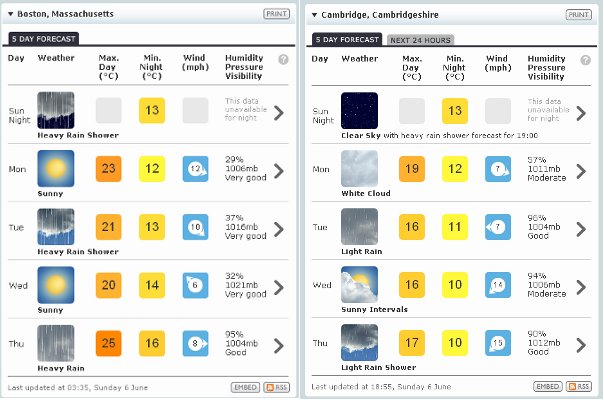
Today, I’m leaving Cambridge, England for Cambridge, Massachusetts. It’s only a short trip – 4 days or so, Vulcan permitting – but I’m very excited, as it will give me an opportunity to visit the Berkman Center for Internet and Society, a Mecca of scholarship on information policy which I’ve been wanting to make a pilgrimage to for at least the last five years.

The weather forecast looks confusing in terms of packing, although not too dissimilar to home:

Links for this week

Every week, I help compile a short mailout of interesting stories for the Open Society Institute’s Information Program, which aims to update their colleagues in the Soros network and friends further afield about the news, opinions and events the Program team have their eye on. Since the mailout is released Creative Commons, and usually contains a really excellent spectrum of information society issues, I also share the links on this blog.

Can India stop ACTA?
Michael Geist analyses the news that India may form a coalition of developing economies against the controversial anti-counterfeiting treaty currently being negotiated by the world’s richest nations.

Pakistan lifts ban on Facebook
The UK’s Guardian newspaper reports that Pakistan has lifted a two-week ban on Facebook, following controversy surrounding “blasphemous” depictions of the prophet Muhammad. Pakistan has stated that it plans to continue blocking individual pages on Facebook.

Leading scientist warns against patenting synthetic life
Professor Sir John Sulston has warned that efforts to patent the first synthetic life form would give its creator, Craig Venter, a monopoly over too wide a range of genetic engineering techniques.

Medvedev views Internet as Russia’s route to direct democracy
Russian President Dmitry Medvedev has publicly suggested that the internet will transfer Russia from a representative to a direct democracy: “I am absolutely confident that there will come an epoch of return from representative democracy to direct democracy with the help of the internet”, he said.

Research shows young people do care about privacy online
New research from the Pew Internet and American Life Project shows that more than two thirds of American social networking users ages 18-29 have changed the privacy settings to limit what they share with others.

Publish What You Spend
A former aid monitoring coordinator for Transparency International Georgia lifts the lid on secret NGO budgets: “Secrecy and charity make for strange bedfellows. Those who spend the public’s money in the name of the poor have a duty to make themselves accountable to rich and poor alike by publicly explaining how this money is being spent.”

Cutting through the hype: citizen reporting vs election monitoring
Responding to hype surrounding the growing use of mobile phones to report incidents during elections, MobileActive.org draw a much-needed line in the sand between citizen reporting and systematic election monitoring.

7 Things You Should Know About OER
This Educause Learning Initiative factsheet is a good introduction to open educational resources, what they are and why they matter.

Sage Bionetworks conference: data and health
A video recording of Dr. Stephen Friend’s introduction to April’s Sage Bionetworks Congress on radically accelerating disease treatment discovery through the use of large, open datasets.

Digital Activism Decoded
This recently published book promises to aid understanding of the mechanics underlying digital activism: “This new field, its dynamics, practices, misconceptions, and possible futures are presented together for the first time”. The book is available for free download.

Networks: Welcome to the Labyrinth

Me at the Resonance studios

Nervous, moi?

Last month, as the nation went to the polls, I went to the Resonance 104.4 FM studios to record an hour’s worth of live, unscripted chat with the marvelous Ken Hollings. Each week, Hollings gathers ne’er-do-wells like myself to discuss the future viewed from the past, analysing the techno-dreams of our ancestors from the safety of a lost pavilion in “Hollingsville” – his putative abandoned and overgrown World Fair.

The show can be streamed or downloaded, and it includes musical interludes from Richard H. Kirk.

The week I went in the topic was Networks. We talked about Norbert Wiener, about Skinnerism, about labyrinths, and about the balls of string that guide us through them. We discussed utopias and dystopias, and wondered whether Facebook made us “compete as slaves” as Wiener warned we must if we entered into the wrong relationship with our machines. We talked about “Homesteading the Noosphere”, about Stewart Brand and John Perry Barlow’s Wild West fantasies, and about the FBI, 9/11 and the Saudi Arabian telephone network the day the first Gulf War started.

All in all, it was as far away from my appearance on Radio 4’s Today programme as a piece of radio could ever get, and although I was nervous when I went into the studio (not least because our fellow interlocutor, Alfie Dennen, had been laid low at the last minute by a ravaging tooth complaint), I ended up truly loving it.

And if you listen carefully, you should be able to guess the details of the project I’m working on at the moment. Of which more anon…