2010 in review

The stats helper monkeys at WordPress.com mulled over how this blog did in 2010, and here’s a high level summary of its overall blog health:

Healthy blog!

The Blog-Health-o-Meter™ reads Fresher than ever.

Crunchy numbers

Featured image

A helper monkey made this abstract painting, inspired by your stats.

A Boeing 747-400 passenger jet can hold 416 passengers. This blog was viewed about 2,800 times in 2010. That’s about 7 full 747s.

In 2010, there were 43 new posts, growing the total archive of this blog to 68 posts. There were 8 pictures uploaded, taking up a total of 1mb.

The busiest day of the year was November 25th with 137 views. The most popular post that day was Social bibliographies and collaborative reading: you’re doing it wrong .

Where did they come from?

The top referring sites in 2010 were twitter.com, cbc.ca, zotero.hypotheses.org, oblomovka.com, and blog.okfn.org.

Some visitors came searching, mostly for becky hogge, aids visualisations, barefoot technologist, stewart brand monsanto, and what happened to ntk.

Attractions in 2010

These are the posts and pages that got the most views in 2010.

1

Social bibliographies and collaborative reading: you’re doing it wrong November 2010
4 comments

2

About Becky Hogge June 2009

3

Data dot (dot, dot): the story of open government data May 2010
2 comments

4

Stewart Brand January 2010
8 comments

5

Portfolio July 2009

27c3 highlights: We came in peace

27c3 lands in BerlinThe 27th Chaos Computer Congress, which wound up yesterday in Berlin, was predictably fantastic. It’s the second time I’ve elected to flee the bosom of my family the day after Christmas to spend a few days in a basement with the world’s nicest hackers, and I have no regrets. This year’s congress not only had more snow (contributing to a not unpleasant feeling that I might be stranded in Chaos forever) but also, thanks to Wikileaks, better journalists AND better spies. Here are my highlights:

Rop Gonggrijp’s keynote speech

The big one. Rop opened the congress with an epic and thoughtful keynote that revisited his “We lost the war” speech at 22c3 five years ago, and plotted a courageous and critical path forward for the community in a post-Wikileaks age. By all means watch the video once, but you’ll also want to read the transcript Rop has posted to his blog. This speech will be a set text for students of the movement in years to come.

Jeremie Zimmerman demystifies ACTA

With the text of the dread anti-counterfeiting trade agreement (ACTA) finalised, La Quadrature du Net’s Jeremie Zimmerman set out what’s at stake if it gets adopted by the European Parliament in a vote scheduled for the first half of next year. Clear, precise and accessible, this is the video you should be sending your friends and relatives to in order to explain the issues and convince them to lobby their elected representatives. Speaking straight after Rop, Jeremie had a tough act to follow, but he brilliantly turned the mood from introspection to action.

SMS-o-Death

Veteran hackers may have found this one a bit slow, but for me it perfectly demonstrates what CCC is here for. After detailing their experiments sending semi-random payloads via SMS to “feature phones” (those cheap, durable handsets beloved of Mums everywhere that sit in the middle of the spectrum between smart and dumb), Collin Mulliner and Nico Golde revealed the fatal and often incurable vulnerabilities they had found, and the almost universally mute response they had had from handset manufacturers in response. Having learnt about the work of OpenBTS and other grassroots GSM networking projects at the last CCC, it was gratifying to see that work applied. The talk was also a good reminder of how seriously the security community takes its responsibility as the public’s eyes and ears against vendors selling damaged goods.

Video available here.

Is the SSLiverse a safe place?

The talk I wish I hadn’t missed. My travelling tech support went to this, and reported it excellent. Using recently reported man-in-the-middle attack vulnerabilities in SSL based on corrupt SSL certification as a jumping off point, the EFF set out to survey the SSL certification landscape. Their diagnosis is frightening.

Video available here.

“The Concert”: A disconcerting moment for free culture

On top of the real spies and real journalists, 27c3 also had real musicians. “The concert” was my ultimate congress high point, and I’m sorry to say that the video is unlikely to communicate the magic that happened in Saal 1 on the evening of Day 2. But I predict that this isn’t the last time you’ll see Alex Antener, Corey Cerovsek and Julien Quentin put on this piece they premiered at 27c3. I wouldn’t be surprised if they hadn’t done TED by the end of next year.

Video available here.

Disco ball at CCC

Image credits: anders_hh@Flickr

Links for week ending 17 December 2010

Venezuela: Last minute law proposes tight internet controls
The Venezuelan government has introduced a bill to reform existing telecommunications law in order to give authorities greater power to regulate and control the internet. Proposals include the creation of a national Network Access Point to give the government the ability to “manage” all Venezuelan internet traffic, as well as measures to prevent anonymity online. “Watershed” proposals, regulating different types of content at different times of day in order to protect minors, are also said to be included in the bill, which will come before the outgoing National Assembly just weeks before it is replaced in 5th January by newly elected members. Critics have called the proposals arbitrary and unworkable.

Trouble brewing at the UN over internet governance
The United Nations is preparing to renew the mandate of the Internet Governance Forum (IGF) for a further five years. IP Watch report that civil society and industry groups are jointly preparing a letter of protest against the UN’s decision to exclude them from processes intended to improve the IGF. Meanwhile, Brazil has called on the UN to establish an international body that would allow governments “to multilaterally address efforts by some to control the internet”, in reaction to recent unilateral action taken by the United States to suppress WikiLeaks.
IGF | Brazil

Hungarian Government ready to give access to communist-era files
Politics.hu report that the Hungarian government is likely to give the go-ahead to publish classified data on communist-era informers. The data was originally stored on magnetic tapes and has been digitised with the oversight of a committee of experts headed by historian Janos Kenedi. Kenedi has previously argued that the files should be made public long before their official declassification date of 2060.

Berkman Center announces digital public library initiative
The Berkman Center for Internet and Society at Harvard Law School have announced a new initiative, funded by the Alfred P. Sloan Foundation, to plan a “Digital Public Library of America”. The planning program aims to define the scope, architecture, costs and administration of the library, and will be guided by a steering committee that includes Internet Archive founder Brewster Kahle, historian Robert Darnton, and freedom of information activist Carl Malamud.

“Cuba opens new online frontline in war of words”
The UK Guardian reports that Cuba has unveiled its own version of Wikipedia – “EcuRed” – this week. The site was developed by Cuba’s Youth Club of Computing and Electronics, an affiliate of the Communist Youth Union. Unlike Wikipedia, the site requires would-be editors to seek authorisation from administrators before they can make changes.

Global Voices: Around the world with WikiLeaks
Global Voices comes into its own with this collection of reactions from countries and regions around the world to the leaked US Embassy cables.
Africa | China | Ecuador | Latin America | Morocco | Singapore | Taiwan | Tunisia

In defence of DDoS
Evgeny Morozov uses the recent campaign of distributed denial of service (DDoS) attacks, launched by internet collective Anonymous against corporations who have denied goods and services to WikiLeaks, to discuss if and when DDoS attacks should be viewed as a valid form of civil disobedience in this article for Slate.com: “While Anonymous’ attacks fall short of Rawls’ high standard for civil disobedience, we should not prejudge all DDoS attacks to be illegitimate.”

How data analysis helped secure conviction in historic human rights case
Benetech founder Jim Fruchterman provides a detailed account of how the work of the Benetech Human Rights Program helped lead to the conviction of two former police officers in Guatemala, for the forced disappearance of student and union leader Edgar Fernando García in 1984: “The García case is the first in Guatemala based primarily on archive documents and paves the way for judges to trust these records – and statistical findings – as evidence in future trials.”

@MedvedevRussia, are you listening?
A review of Russian President Dmitri Medvedev’s first six months on Twitter, as seen through the Russian blogosphere: “Apple should almost be paying him for the publicity”.

Goodbye to the printed newspaper?
John Lanchester examines the state of the newspaper industry, and plots one path towards a viable future, in this long essay for the London Review of Books.

Leaving Facebook
A Diaspora beta tester details her experiences for Technology Review: “The goal isn’t to replace Facebook or any other service as a way to interact online but to eliminate the need to store private data on multiple websites, many of which seem geared to an all-or-nothing sharing of personal information.”

Podcast: Milton Mueller on internet governance
Milton Mueller, Professor and Director of the Telecommunications Network Management Program at the Syracuse University School of Information Studies, tries to bring back some cyber-libertarianism to the internet governance discussion for the podcast series “Surprisingly Free”.

Links for week ending 10 December

EFF takes stand against internet censorship
The Electronic Frontier Foundation (EFF) this week asked its supporters to join it in taking a stand against internet censorship, condemning the extra-judicial censorship of WikiLeaks in the United States: “Like it or not, WikiLeaks has become the emblem for one of the most important battles for our rights that is likely to come along in our lifetimes. We cannot sit this one out.”

Russia drops piracy case
Russian authorities have dropped charges of software piracy against Russian environmental NGO Baikal Environmental Wave after Microsoft indicated it would not support the case. Police raided the group’s offices in Irkutsk in January this year, confiscating 12 computers in what environmentalists say was a politically motivated operation.

Disruption to mobile services in Turkmenistan may be linked to licence negotiations
Reports are appearing on the Russian-language web that telecommunications company MTS is coming under pressure from authorities in Turkmenistan to share a greater proportion of its profits, ahead of negotiations for a new licence to operate in the country. MTS services went dark on 3 December in the capital Ashgabat due, according to a spokesperson, to an “accident…not caused by our company”. Via Google Translate: “Analysts do not rule out that the aspiration of the Turkmen authorities to take control of an extremely lucrative telecommunications business is related to a critical decrease in receipt of money in the coffers [from] the sharp drop in sales of Turkmen gas.”

Phone messages to boost African farmers
The International Finance Corporation and the Soros Economic Development Fund have invested $2.5 million in Esoko, a mobile-driven platform that delivers real-time market data to African farmers. The system is currently being piloted in northern Ghana. “The farmers seem to be getting between 20-40% revenue improvements,” Esoko founder Mark Davies told Reuters.

Venezuelan regulator proposes more controls on Internet content
A memo written by the national telecoms regulator of Venezuela to the country’s Vice President has been published by TV network Globovision. The memo recommends that the regulator, Conatel, be empowered to remove content from the internet and to apply sanctions where necessary, and includes outlandish proposals for “supervising” social networks at key times of day when they are used by minors.

WikiLeaks controversy shines a light on the limits of techno-politics
This blog post by writer Tom Slee outlines the challenge that the unfolding case of WikiLeaks presents to those who have previously eulogised the net for its disintermediating qualities and transformative potential: “The cables prompt some tough questions, but the fault lines those questions reveal run perpendicular to digital attitudes, not parallel…the Internet is a new terrain, but the battles being fought on it are old ones.”

Briefing: routing on the internet
This overview from Security Week provides a fairly accessible introduction to current issues in internet routing and their likely effects on the security of the net.

The mismeasurement of science
Michael Nielsen discusses the difficulties of measuring scientific contributions: “heavy reliance on a small number of metrics is bad for science”.

Russia: Competing models of internet politics
This Global Voices feature characterises the many sides of public debate currently taking place in Russia about the role of the internet in politics: “Despite the government ideologists’ efforts to sell the idea of preserving the hybrid regime by introducing superficial – though hi-tech – innovations, the internet provides a new environment that no one, not even the government, can fully control”.

Video: Tom Steinberg on Open Government Data
Presenting at the Open Knowledge Foundation’s Open Government Data Camp last month, mySociety’s Tom Steinberg attempts to chart a smooth course for the open data movement now it has the attentions of government. You can watch the talk on video, where Tom is joined by Sir Tim Berners-Lee and Nigel Shadbolt, or read a transcript of the talk on Tom’s blog.
Video | Transcript

Links for week ending 3 December 2010

US shutters 82 sites in crackdown on downloads and counterfeit goods
Following investigations by federal agents, 82 websites accused of supplying counterfeit goods or facilitating music piracy had their domain names “seized” on Monday this week by ICE, the United States’ Department of Homeland Security Immigration and Customs Enforcement agency. Warrants for the seizures were issued by a District court.

Free media under siege in Egyptian elections
Foreign Policy reports details of a concerted media crackdown in Egypt ahead of last Sunday’s parliamentary elections. Mass text messaging and live television coverage of election-day events are also reported to have been restricted.

Internet blocking: key decisions in the pipeline for Europe
European Digital Rights (EDRI) report that a legislative process to implement internet blocking of images of child sex abuse is about to accelerate. Campaigners fear that the proposals will establish a Europe-wide online censorship infrastructure ready to be extended to more controversial blocking requests, while at the same time doing little to combat the sexual abuse of children. EDRI have prepared a booklet aimed at informing EU officials about the complex issues surrounding the issue, which is available in several European languages.
Report |Booklet

European Commission launches investigation into Google
The European Commission has launched an anti-trust investigation into Google’s business practices, following complaints from three companies, including Microsoft, that the online giant is abusing its dominant position in the web search market to promote its other services. The investigation will be the first of its kind directed at Google and is likely to last several years.

India district bans cell phones for unmarried women
A local council in Uttar Pradesh state, India, has banned unmarried women from carrying mobile phones, following concerns phones were being used by young couples who planned to marry against their parents’ wishes.

Shunned profiling technology on the verge of a comeback
The Wall Street Journal reports that deep packet inspection, “one of the most potentially intrusive technologies for profiling and targeting Internet users with ads”, is about to make a comeback in the United States, thanks to deals being struck by two ad-targeting companies, Phorm Inc and Kindsight Inc. The news comes two years after an outcry by privacy advocates in the US and Britain appeared to kill the technology.

If Amazon has silenced Wikileaks…
Ethan Zuckerman reacts to reports that Amazon has responded to political pressure from the US Senate and booted whistle-blowing website Wikileaks from their cloud-hosted web server service: “If Amazon did respond to pressure… it should open a conversation about the responsibilities of cloud providers towards clients who host political content. If Amazon’s policy is ‘we can terminate you if we’re uncomfortable with what you say’, that cannot be acceptable to anyone who is concerned with freedom of speech online.”

Uganda: ICT boom for economy is a bust for some women
Anecdotal evidence that the rise of mobile phone ownership in Uganda has also seen a rise in “SMS stalking, monitoring and control of partners’ whereabouts”, is backed up by a new study showing that nearly half of mobile phone owners had problems with spouses in relation to their use: “The research shows that communities are having difficulties coming to terms with the power of technology to bring about freedom for women.”

What to watch out for in Free Trade Agreements with the United States
This detailed factsheet, produced by Médecins Sans Frontiers, is aimed at civil society groups operating in countries with whom the United States is negotiating Free Trade Agreements. It explains some of the technical terms associated with new patent and enforcement provisions, and these provisions’ implications for access to medicines.

Africa Portal
The Africa Portal aims to equip users with research and information on Africa’s current policy issues. It includes an open access repository of over 2,500 books journals and digital documents. “A portion of the digital documents housed in the library have been digitized for the first time as an undertaking of the Africa Portal project. Facilitating new digitization projects is a core feature of the Africa Portal, which aims to improve access and visibility for African research.”

Podcast: Radio Berkman
In the latest edition of the excellent Radio Berkman podcast series, David Weinberger interviews Joseph Reagle about his new book, “Good Faith Collaboration”, which examines the evolution of cultures of collaboration in the Wikipedia community.

Data visualisation: Mapping a day in the life of Twitter
This 3-minute video plots 530,000 tweets (the sum of all geo-coded tweets posted to Twitter on one day in November) on a map showing, in accelerated form, a day in the life of Twitter across the world.

Links for week ending 26 November 2010

US Senate Committee approves internet censorship bill
The EFF report that the Senate Judiciary Committee has approved the Combating Online Infringement and Counterfeits Act (COICA). The draft law proposes giving the government power to use the Domain Name System to boot copyright-infringing websites off the net, and has attracted expert and bi-partisan criticism. Debate on the bill will now move to the Senate at large.

India finalises policy on open standards
The Centre for Internet and Society report that after three years of intense lobbying and debate, India has finalised its policy on Open Standards for e-Governance. The policy represents an important victory for the open source software community, as it excludes patented software that requires royalty payments from being considered an open standard.

Google charges US authorities $25 a head for user surveillance
The results of a Freedom of Information request to the US Drug Enforcement Administration have turned up information about how much different internet companies charge to wiretap their customers. While Microsoft does not charge authorities who make authorised requests for wiretaps, Google charges $25 and Yahoo! $29 per customer wiretapped. The Register report that in 2010 the DEA paid ISPs, telcos, and other communication providers $6.5 million for wiretaps.

Syrian bloggers brace for fresh blow to Middle East press freedom
Media analysts say that parliamentary approval for a draft law in Syria that would require bloggers to register as journalist union members is likely to come soon. The Christian Science Monitor reports: “Online journalists and bloggers in Syria, already subject to harassment and imprisonment, are concerned that the law is designed to crack down on their activities and restrict freedom of expression.”

WIPO to work on library and archive copyright exceptions
EIFL report that the new workplan for WIPO’s Standing Committee on Copyright and Related Rights (SCCR), agreed earlier this month, not only includes proposals to take forward a treaty to guarantee access to reading materials for the visually impaired, but also allocates time for “text-based work on appropriate exceptions and limitations for libraries and archives”. EIFL, who have been working with the SCCR to reach this point for six years, call it an “unprecedented opportunity for libraries and archives”.

Long live the web: a call for continued open standards and neutrality
Tim Berners-Lee makes the case for why the web will flourish in the future only if we protect the medium’s basic principles, in this long essay for Scientific American.

Information technologies & international development
This special collection of essays includes contributions from Amartya Sen, Ethan Zuckerman, Yochai Benkler and Lawrence Liang.

Cyber Con
This long essay by James Harkin for the London Review of Books uses the publication of three new books on technology and geopolitics to launch a critique of the US State Department’s “internet freedom” agenda in the Middle East.

Russia’s Cyrillic cybernauts
This Financial Times feature on the Russian internet examines patterns of ownership among major Russian technology and media companies, their links to the Kremlin and the potential ramifications for privacy and free expression those links might have.

Global science
This Economist feature sums up the findings of a recent UNESCO report into the current status of science around the world. It finds that although emerging economies are increasing the amount of money they spend on R&D, citations originating from these countries remain low.

Blog: Don’t trade our lives away
The Delhi Network of Positive People (DNP+) and Medecin Sans Frontiers have set up a new blog – Don’t Trade Our Lives Away – to share documents, pictures and news on the draft India-EU Free Trade Agreement (FTA). NGOs in India are campaigning against the FTA, and against related international trade arrangements such as ACTA – citing their catastrophic effects on access to medicines.

Social bibliographies and collaborative reading: you’re doing it wrong

Recently, I have been playing around with the various tools and services available to people who want to store and share their bibliographies and research materials online. Such services are currently blossoming, and for a quick overview of what’s out there, I’d suggest starting with this review written by Eugene Barsky at the University of British Columbia.

My aim in all of this was to explore the options for creating a hub where people interested in emerging technologies and their implications for society could share and discuss scholarly materials – books, book chapters, academic papers, lecture videos etc. I think that what I had in mind was a bit like PLoS Hubs. As PLoS write in their blog post introducing the PLoS hubs biodiversity project:

“The vision behind the creation of PLoS Hubs is to show how open-access literature can be reused and reorganized, filtered, and assessed to enable the exchange of research, opinion, and data between community members.”

So, were any of the existing tools and services powerful enough to mirror the functionality offered by PLoS Hubs? I looked at Mendeley, Zotero, Wizfolio, Scribd and Connotea. The answer I’ve come to so far is… not quite.

That’s not surprising. Note that PLoS Hubs works exclusively with open access literature, which means they can import whole journal articles to their platform without violating copyright. By contrast, a lot of the material I want to highlight on my hub is protected by copyright. So although I can easily collate links to materials, visitors to my hub are going to have to go back out to the web to read some of the material I’m highlighting, and that might leave them less inclined to return back to start a conversation about it. That’s without even going into the tricky subject of whether they benefit from access to the same institutional subscriptions I do: I could be pointing to materials that, for them, are locked behind a subscription paywall they have no credentials to vault.

Of course, I could always break copyright law: most of the platforms I tested (with the exception of Connotea) have facilities to upload and share files direct from the platform, with some element of free storage. The platforms are wise to this, and employ various strategies to dissuade their customers from breaking copyright terms, from showing prim pop-up windows (that I presume they hope have the effect of transferring the liability for the infringement from them to you) when you upload a file (Zotero, Scribd) or opt to share it (Wizfolio) to only allowing you to upload files through a convoluted process involving a desktop client (Mendeley).

Setting the problem of copyright aside for now, I discounted two of the services right off the starter blocks: Scribd because I really dislike their reading pane and because it was fully public, with no option to share references among a private group; and Connotea because it had no option to upload files even if they were files you were permitted to upload. I then set about testing the remaining three products – Wizfolio, Mendeley and Zotero. One of the ways I used to test them was in collating a bibliography from Gabriella Coleman’s fantastic contribution to the Atlantic syllabus series “The Anthropology of Hackers“.

Wizfolio

Why did I end up starting with Wizfolio? I think it’s because it has the fastest and cleanest interface. Perhaps I was exposed to too many FileMaker Pro-based database tools at an impressionable age, but the forms Wizfolio uses just felt right. I might not have thought that had I not had AdBlock running on Chrome – the service is ad supported, and if you look at it without AdBlock on, it’s a totally different experience.

Wizfolio’s web button “WizAdd” also performed best out of the three products, picking up that I wanted to save a journal article and automatically fetching all the right details when I visited a web page like this which listed it, where the other two products’ web buttons thought I wanted to save a web page.

Wizfolio’s auto-complete for bibliographic detail was also the most efficient, even though it kept trying to locate the titles of the papers I was saving in PubMed. Adding books to the bibliography was a pleasure, it took less than a second after I’d inputted the ISBN number before Wizfolio had found it through Google Book search and could auto-complete the rest of the details for me, as well as supply a jacket picture and link to a preview on Google Books. Sweet.

Unlike Mendeley, Wizfolio is totally web based. This is good in one sense: the time Mendeley spends syncing your desktop library with your web library is probably best spent on other things. But it’s bad in another sense: any collection you build up of actual files could be gone the moment Wizfolio decides to withdraw its service from you, so you ideally need to be maintaining a desktop mirror in parallel – easy if it’s just you, less easy if you’re building up a library collaboratively.

Finally, there is very little that’s social about Wizfolio. Yes, you can share your bibliographies with colleagues, and you can even make them public. But I’m not sure what public means in this context: Wizfolio didn’t generate a url for the collection, so I’m forced to provide only an image of the final result:
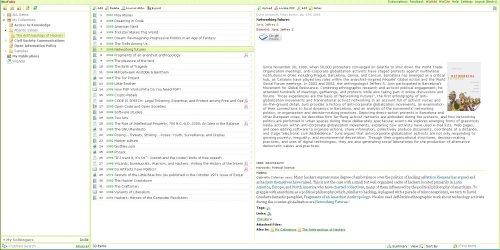
Screenshot from Wizfolio

Notifications about the activities of your colleagues online were delivered in Windows Messenger-style floating pop ups, and no record of social activity was maintained. Colleagues were unable to leave notes on papers you had shared with them to start a conversation about the text. So although Wizfolio scored highly on user experience making and maintaining bibliographies, it was all a bit 1.0. It was clear I was going to have to look elsewhere to scratch the social itch. Luckily, Wizfolio let me export the references I’d inputted as a .RIS file, which I could then input to the other two services I was testing.

Mendeley

I’ve alluded already to a lot of what I didn’t like about Mendeley – the baggy desktop client, the poor web import button. Although I’ve said I didn’t rate the auto-complete functionality for bibliographic details, that’s more about usability than it is about performance – the interface is just unpleasant. I simply don’t think I could get used to the separation of powers between the desktop client and the web instance of my library. But I’m not going to give up. I’m attending this talk from the Mendeley people on Friday, so maybe I’ll get a better feel for how to use the product there.

What I initially loved about Mendeley, though, was how social it felt. I spent a good bit of time filling in my profile details – a sure sign I thought I was going to make some friends. The interface is very Facebook. And I admit it, the Ajax felt good after an hour-or-so’s form-filling at Wizfolio.

After I’d imported the .RIS file from Wizfolio to the Mendeley desktop client, I added the items in it to a new public group library called “The Anthropology of Hackers”. I then synced the desktop client with the web client, went off and made myself a cup of tea, and came back to see how things were going. The result is this (click the picture to go through to the library and have a look around):

Screenshot from Mendeley

You can see that the references haven’t come through all that cleanly, but that’s probably my fault as much as Mendeley’s – I wasn’t all too thorough when I inputted them into Wizfolio. What’s really annoying, however, is the weakness of the discussion facility. Each paper has its own page with a url, but there’s no comment facility so you can’t start talking about what’s in there. You can comment on the status update displayed on the Overview page (pictured), where it shows you I’ve uploaded some references, but for me that’s not the best place to be starting a conversation, especially as the upload messages are presented in batches. What do I want? I’m not sure. A forum? Comments under the papers? Paper fan pages? I don’t know what it is but I know I want something more from a site that looks this social.

Zotero

I looked at Zotero last because it’s Firefox-only, and Firefox is no longer my browser of choice thanks to how baggy it’s got over the past few years. Like Mendeley (and, by the way, unlike Connotea) it also had no trouble reading the .RIS file from Wizfolio. It also had a number of other features I liked. For a start, unlike Mendeley, it let me create sub-folders in my shared collections, and didn’t restrict the number of people with whom I could share a private collection (with Mendeley, the limit is 10).

Zotero also allowed me to export my bibliographies in a wide variety of formats. Whereas Mendeley would only offer me a Word plugin or a BibTeX export, and Wizfolio restricted itself to exporting a .RIS file, Zotero would let me get at my data in .RDF, MODS, BibTeX, BibIX, .RIS – even as a Wikipedia citation template. This is exactly the kind of good practice you would expect from a FLOSS project, which is what Zotero is. Zotero will also produce straight text bibliographies that conform to a range of bibliographic conventions, to cut and paste wherever you fancy.

As far as social features are concerned, Zotero does have some good ones, although they were hard to find initially. As well as providing a permanent url for your various collections which is publicly accessible, you can create groups with whom you can share your collections, and you can even start discussion threads on the group pages (horray!). Here’s a publicly accessible (but closed membership) group I created as a test, with the Anthropology of Hackers bibliography listed as a collection (again, click the picture to go through to the library and have a look around):
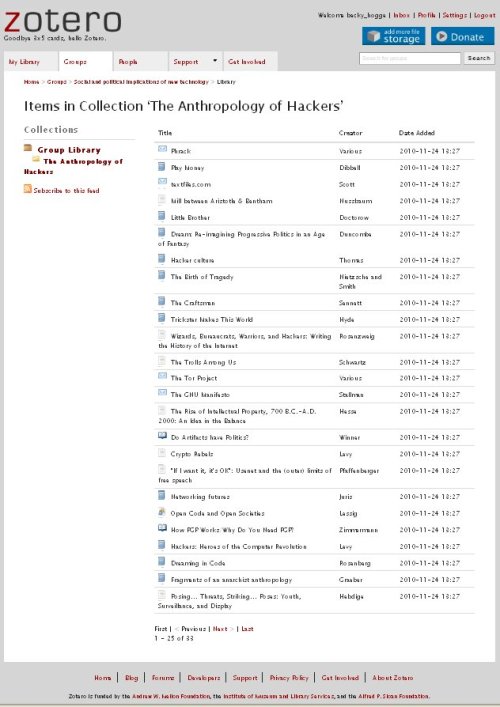
Screenshot of Zotero

Although it’s not as pretty as Mendeley, then, Zotero does appear to have more smarts. And of the three tools I looked at I think it comes out (so far) as the favourite contender for creating my hub.

Social bibliographies and collaborative reading: I’m doing it wrong

If you’ve played a part in writing any of the tools I’ve talked about in this post, or if you’re a protective power-user, please don’t feel aggrieved if I’ve got it wrong, and please feel free to leave guidance in the comments.

Although I’ve now spent quite a while in the company of these three tools, I feel like I’ve barely scratched the surface, and I certainly am not ready to call a winner. For one thing, it feels like most of these tools are still in development. I can imagine Mendeley will be working up some more engaging social features to live up to its compelling feel in the near future. I suspect Wizfolio will continue to integrate with professional journals to take its auto-complete functionality further towards the seamless end of the spectrum.

Until I’m clear what I want to achieve with this hub (who knows, I might turn out to be looking for a solution to a problem that doesn’t exist) I’m going to keep experimenting with all three of these tools and whatever else comes my way. And I’ll try and keep this blog updated with what I find.

ORG is 5!

ORG is 5 logo

Happy birthday to the Open Rights Group, which turns five today.

It’s hard for me to imagine a world without ORG, and not just because I had the pleasure of running it for two years. In the five years since it was founded by 1,000 concerned citizens, ORG has been a crucial voice in debates as far-ranging as whether we should trust computers to tabulate and count votes for us in elections (we shouldn’t) to whether we should let internet service providers snoop on our browsing activity in order to sell us advertising (we shouldn’t do that either). And of course, ORG has played centre stage in national, European and global campaigns to make the intellectual property framework work for citizens and consumers. I’ve been an ORG supporter for five years and I know better than anyone how crucial my monthly £5 is to ORG’s continued success.

It’s more than just the money. Having a predictable future income helps ORG plan campaigns in the long term – vital if they are to match the considerable lobbying clout of the incumbent rightsholders and new internet giants that flood Westminster and Brussels with legislative and regulatory proposals that are not always in the public interest. Having a sustainable core financial base is a great selling point to grant funders who tend only to want to make project-based grants. And being able to tell legislators that the reason you are here in front of them is because over 1,500 citizens have decided you need to be and put their hands in their pockets to make it happen is a very powerful message indeed. If you haven’t joined the Open Rights Group yet, there are three good reasons to do so today. Go on. Do it.

And now for something a little more whimsical. Here’s the piece I wrote for openDemocracy five years ago to celebrate the founding of ORG. Enjoy:

Tonight, I am following in the footsteps of a Grateful Dead lyricist, Sun Microsystems’ fifth employee and the inventor of the spreadsheet. Like John Perry Barlow, John Gilmore and Mitch Kapor, who together founded the United States-based organisation the Electronic Frontier Foundation (EFF) in 1990, I am starting my own campaigning group for online rights. Well, I can’t take all the credit. Together with over 1,000 other people I have pledged that I will pay £5 (approximately $8) each month for the sake of a voice in an arena where our future online civil rights are at this very moment being put to paper.

It’s an innovative way to start a campaigning organisation. Not until a critical mass of 1,000 people had been reached (with a last-minute call from cult blog BoingBoing for the final thirty-three signatories) could the Open Rights Group (Org) come into being. Using Pledgebank.com, a site designed by British civic participation hackers MySociety, the co-founder of British netzine Need to Know Danny O’Brien (himself an EFF émigré) started the process off. He pledged that if 1,000 people would join him, he would commit to funding a modest advocacy group that would give a voice to young technologists in the press and at the drafting table to the tune of £60 a year.

This bottom-up approach is testament to the organisation and the values it represents. But the thrill of being involved has not allowed the Org project to pass by without criticism – in fact, the openness of the group has exposed it to heartfelt involvement from many sides. But the project has already met with its first success. In speaking out against content owners’ desire to be treated as equal to security services in terms of access to electronic personal data – a piece of draft law currently being fast tracked through the European Union – Org has finally added the crucial alternative voice in the modern dialogue of online rights.

Campaigning for digital rights is a very wide mandate. Not only is access to the internet increasingly, and rightly, being seen as a basic right, but the traditional concerns of civil rights are magnified in the virtual world. With more personal data swimming around in the ether than ever before, and with security services more enthusiastic than ever to get their hands on it, privacy is top of the agenda, and hopelessly skewed. Likewise freedom of speech. The recent sentencing of Chinese journalist Shi Tao on the strength of evidence provided by a third party global corporate entity should prove that the impossibility of global governance of the net also has its downsides.

Links for week ending 19 November 2010

Final ACTA text officially released
IP Watch report that the US Trade Representative (USTR) have released what they say is the final text of the Anti-Counterfeiting Trade Agreement, subject to a legal review that will take place in Sydney, Australia in early December. The text will then go to national governments to “undertake relevant domestic processes”, USTR said.

Number of mobile subscribers in Africa hits 500 million
The African continent is now home to over half a billion mobile subscribers, according to a new poll by Informa Telecoms and Media. The milestone coincides with the 25th anniversary of mobile telephony in Africa.

China Telecom rejects claims it hijacked US web traffic
China Telecom has rejected claims it hijacked a proportion of internet traffic in April 2009. The accusations surfaced in a report published this week by the US-China Economic and Security Review Commission. The report claimed China Telecom rerouted sensitive US web traffic to China, including traffic destined for the websites of the US Senate, the Office of the Secretary of Defense, NASA and the Commerce Department.

Police put pressure on ISP to close down website in UK
Police in the UK have forced the suspension of a website, FITwatch, that has been engaged in sousveillance of police “Forward Intelligence Teams”, teams of police officers who gather intelligence about political activists at demonstrations and protests through overt surveillance. The suspension follows recent violent protests against rises in student tuition fees, and was initiated via the website’s hosting provider, JustHost.com.

Illegal communications surveillance uncovered in Trinidad and Tobago
Police have raided a “secret snooping agency” within the National Security Ministry of Trinidad and Tobago, bringing to light an extensive list of people whose phone calls, text messages and emails have been monitored over five years. The list includes Prime Minister Kamla Persad-Bissessar. Investigations are ongoing.

WIPO Copyright Committee agrees to extra time on visually impaired access
Following negotiations that stretched past midnight on the last day of meetings of WIPO’s Standing Committee on Copyright and Related Rights (SCCR/21), delegates have agreed on a work programme to aid access to reading materials for the visually impaired. The programme stipulates three extra working days to be dedicated to discussions on limitations and exceptions to copyright law. Knowledge Ecology International and the World Blind Union have been the key advocates during negotiations.

Can technology end poverty?
This Boston Review special forum presents contrasting perspectives on the contribution of ICT to development. It includes contributions from Nicholas Negroponte, Evgeny Morozov, Archon Fung and Kentaro Toyama.

Tim Wu: The Master Switch
The New York Times talks to Tim Wu about his new book, “The Master Switch: The rise and fall of information empires”, in which he explores the way the open internet might gradually become enclosed by a few dominant US corporations. “My book is a history of information empires in America and the rise and fall of companies like ABC, NBC, AT&T, and eventually Facebook and Google. It’s largely a story of the American affection for information monopolists and the consequences of that fondness.”

Citizen media and digital activism in Kosovo
This feature includes an interview with the editor of Kosovo 2.0, Besa Luci, about the state of online citizen media in Kosovo in the run up to the republic’s first general elections since it declared independence in 2008.

Video: Machine Learning: A Love Story
Hilary Mason, lead scientist at bit.ly, presents the history of machine learning, covering some of the most significant developments that have taken place the last two decades.

Interview with Robert Cook-Deegan of the Center for Genomics at Duke
This short interview conducted by Creative Commons with the Director of Duke University’s Center for Genomics, Robert Cook-Deegan, highlights some of the information-handling challenges that lie ahead for the study of human genomics. While individuals are rightly worried about issues of privacy and abuse of private data, “most research institutions and private firms are more concerned with mining what’s under their control already, rather than sharing and creating value collectively”.

Video: A perfect dystopian storm
This short presentation by Tom Scott at recent conference Ignite London 2 imagines the story of a flashmob gone wrong.

Links for week ending 12 November 2010

European Commission announces review of data protection and copyright frameworks
The European Commission officially announced its much-anticipated review of the EU data protection framework this week. The review will be led by justice commissioner Viviane Reding. Also last week, former competition commissioner and now European Commission Vice-President for the Digital Agenda Neelie Kroes announced the commission’s desire to review the copyright framework, stating “our fragmented copyright system is ill-adapted to the real essence of art”.
Data Protection | Copyright

Attack severs Burmese internet
Distributed denial of service (DDoS) attacks targeting Burma’s main internet service provider effectively took Burma offline last week. Security specialists Arbor Networks report: “While the motivation for the attack is unknown, Twitter and Blogs have been awash in speculation ranging from blaming the Burma/Myanmar government (preemptively disrupting internet connectivity ahead of the November 7 general elections), to external attackers with still mysterious motives”

New challenges imposed by misguided cybercrime draft bill
A2K Brazil report that a draft Cybercrime Bill, dismissed following public outcry in 2009, has been snuck back onto the legislative agenda in Brazil. The Center for Technology and Society at the Getulio Vargas Foundation in Rio de Janeiro have launched several criticisms of the draft proposals, focussed on the fact that they criminalise ordinary consumer behaviour and threaten citizens’ privacy.

LiveJournal suspends accounts of opposition bloggers in Russia and Kazakhstan
Global Voices report two separate instances of blogging platform LiveJournal suspending the accounts of opposition bloggers last week, in Russia and Kazakhstan. LiveJournal is Russia’s most popular blogging platform and was bought by Russian media company SUP in 2007.
Kazakhstan | Russia

Turkey unblocks, then reblocks YouTube
Turkey has reportedly lifted and then reinstated its blocking of YouTube. According to campaign group European Digital Rights (EDRI), the site was originally blocked because it hosted videos considered insulting to Turkey’s founder, Mustafa Kemal Ataturk. That block was lifted at the beginning of November, once the videos in question had been removed by a user. Now the block is back in place because, according to the Open Net Initiative (ONI), YouTube is hosting a potentially compromising video of former opposition leader Deniz Baykal. The Turkish government’s blocking of YouTube is being challenged in court by Istanbul Bilgi University.
Unblocked | Blocked

Focus: Open textbooks
These two articles detail the progress and potential of open textbooks in the United States education system. The first reports on initiatives to drive down the cost of textbooks using openly-licensed solutions, led in Washington State by Cable Green, Director of eLearning and Open Education at the Washington State Board for Community and Technical Colleges. The second is an interview with Eric Frank, the founder of the for-profit open textbook publisher, Flat World Knowledge.
Report | Interview

Book: SMS Uprising – Mobile activism in Africa
Released at the beginning of 2010, this collection of essays examines the use of mobile devices by activists in Africa. It is published by Fahamu Books and Pambazuka Press, and edited by Sokari Ekine.

Book: Access to Knowledge in the Age of Intellectual Property
This new collection of essays from MIT Press charts the rise of the access to knowledge movement, mapping the terrain of legal, cultural and technical issues that activists in the movement negotiate every day. The book includes contributions from Yochai Benkler, Peter Drahos, Lawrence Liang and Senior Information Program Manager Vera Franz. It is available for free download.

Opinion: Facing up to the generational privacy divide
Michael Geist uses the recent annual conference of the world’s privacy and data protection regulators as a springboard into a discussion of our shifting attitudes to privacy online. “Bringing offline social activities to the online environment raise a host of issues”, he writes, highlighting the contexts in which we share information about ourselves as the defining aspect of our subsequent expectations of privacy.